

Breaking the Geis
Why clever final girls are always burning shit down

In Choosing the Knife, I wrote that horror gives women the knife, fairy tales give women the map, and fiction gives women the page. What I didn’t name, what I didn’t have the word for yet, was the thing the knife cuts, the thing the map navigates, the thing the page rewrites.
Now I have the word. It’s Irish. It’s ancient. And a movie about rich Satanists hunting a bride on a golf course just handed it to me on a silver platter.
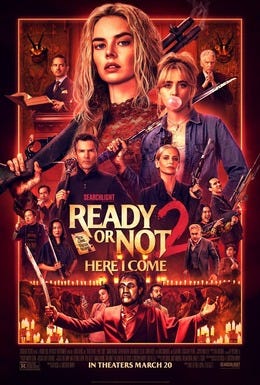
In Ready or Not 2: Here I Come, Grace MacCaullay, our Final Girl still wearing her blood-soaked wedding dress from the first film, wakes up handcuffed to her estranged sister Faith on a golf course. The Le Domas family is dead. Grace killed them. But the Le Domases weren’t the only devil-worshipping dynasty with a sacred pact. Four more families have assembled: the Danforths, the El Caidos, the Wilkinsons, the Rajans. Each one bound by the same demonic deal: wealth and power in exchange for ritual sacrifice. Break the pact, and your guts explode. Literally.
These families didn’t choose their obligation. They inherited it, passed through bloodlines like a curse dressed up as a legacy. Each generation receives the power and the prohibition. You get the mansion, the empire, the High Seat of the Council. You also get the game. You also get the kill.
In Irish mythology, this has a name: geis.
A geis is a sacred obligation placed on a character — a taboo that simultaneously gives them their power and guarantees their destruction.
The Le Domas deal with Le Bail is a geis in its purest mythological form. In fact, every one of these rich, murderous dynasties is living under a geis most of them never agreed to carry but cannot survive without — because the system has made their identity inseparable from their obligation.
I’ve been thinking about this word obsessively now because I think every woman I know carries at least one she never chose.

The Geis You Were Born Into
I’m not talking about the mythological kind, though. Rather, I’m speaking to the inherited kind. The ones encoded so early they feel like personality traits rather than spells.
The silence geis: don’t say the hard thing out loud or you’ll lose the room. The caretaking geis: if you stop holding everyone together, someone will fall apart and it will be your fault. The shrinking geis: you can be powerful or you can be loved, but never both at the same time. The “let it go” geis: what happened to you isn’t worth the mess of naming it.
I used to think of these as voices. Wicked voices, the kind that live in the back of your throat and edit every sentence before it leaves your mouth. Rules and spells cast over your life by people who may or may not have meant to cast them.
Some I inherited at birth. The apology for existing in a body that was touched before it could consent. The template for love that looked like disappearing. The assumption that my needs were negotiable, that the right amount of accommodation could make me small enough to be kept.
Some I accumulated. The one that says if your best was treated as worthless, maybe your best was the wrong best. The one that says if you stop managing his emotions, he might not survive. The one that whispers, every time I reach for pleasure or abundance or the audacious life I actually want: who do you think you are?
Here’s what I’ve learned about wicked voices: the root of the word “wicked” is wisdom. These voices kept me safe once. The shrinking kept me invisible when visibility was dangerous. The silence kept the room intact when the room was all I had. The caretaking gave me a role when I didn’t yet know I was allowed to simply be.
But safety is not sovereignty. And the geis that protects you at sixteen will imprison you at thirty-six if you don’t learn how to break it.

“You’re Not Like Us. You Have Hope.”
There’s a moment in Ready or Not 2 that stopped me cold. A line delivered to Grace, a line that is, I think, the most precise articulation of what the familial geis does to the people inside it:
“You’re not like us. You have hope.”
And Grace’s answer, the Final Girl’s answer, the answer of every woman who’s ever been fed into a system designed to grind her down:
“Not anymore. You took it from me.”
This is the geis being placed on the Final Girl in real time. The family’s laws destroy hope intentionally. Hope is what makes you dangerous. Hope is what makes you fight. So the first thing the geis does is teach you that hope is naïve, that resistance is pointless, that the smart move is compliance. The Le Domas game doesn’t just hunt Grace. It tries to convince her that survival is impossible so she’ll stop running.
But the Final Girl’s move — the move that makes her (or any of us) the Final Girl, is that she doesn’t accept hopelessness. She transmutes it. Grace doesn’t just survive the game. She burns it all down.
And here’s the part that made me want to scream from the fucking rooftops: Grace has to do it because the men can’t.
There’s a scene where Titus Danforth, who is supposed to be hunting Grace, has to break his own family’s rules to call Grace to the lobby because he can’t find her on his own. He has to use her achilles heel to lure her to him. Instead of playing by the rules, instead of admitting that he can be beat, he cheats.
So Grace has to be clever. She has to read the room, recognize the pattern, use the system’s own tools against it. The marriage proposal at the end of the film isn’t Grace giving in to the institution that tried to kill her. It’s her Gretel move. It’s pushing the witch into her own oven. It’s naming Rumpelstiltskin. It’s the fairy-tale heroine’s oldest, most dangerous weapon: I see how your system works, and I’m going to use it to destroy you.
In Choosing the Knife, I wrote that the more agency a genre gives women, the less seriously culture takes it. Horror is dismissed as trash. Fairy tales are dismissed as children’s stories. Romance is dismissed as guilty pleasure. But these are the genres where women fight back, where women survive, where women win — not by being rescued, but by being smarter and more ruthless than the system that’s hunting them.
The geis is what those women are fighting. The geis is the familial law, the inherited script, the sacred obligation that says you must play the game. And the Final Girl is the one who says: I’d rather burn the house down.

The Sister Bond
But Grace doesn’t burn it down alone. And this is where Ready or Not 2 does something the first film couldn’t.
In the original, Grace survived solo. She sat on those mansion steps, covered in blood, smoking a cigarette, magnificently alone. When asked what happened, she said, “In-laws.” It was cathartic. It was iconic. It was also the story of a woman who broke the geis without a witness.
The sequel gives her Faith.
Grace and Faith are estranged sisters, separated by life, by circumstance, by the particular cruelty of a foster system that treats siblings as divisible. They carry the specific grief of sisters who love each other and have no practice at it.
But here’s what the film understands about sibling differentiation: the siblings raised inside the geis — Ursula and Titus Danforth — are compliant killers regardless of gender. The system doesn’t care whether you’re brother or sister. It produces soldiers. Ursula is as lethal as Titus. The families’ children are like-minded because the geis made them that way.
Grace and Faith are different. They exist outside the family’s laws. They weren’t shaped by the pact. And their bond, the sister bond forged not in privilege but in shared survival, turns out to be the strongest thing in the film. Stronger than the demon’s deal. Stronger than dynastic loyalty. Stronger than the sibling rivalry the Danforths weaponize against each other.
The sister-sister bond is the most durable and emotionally sustaining of all sibling relationships. Sisters maintain closer contact, provide more emotional support, report higher levels of intimacy across the lifespan. It’s not sentimentality. It’s structural. Sisters practice the specific relational skill of being known — of witnessing each other without flinching.
Grace and Faith are the village in miniature. Two women who see each other outside the system. Two women who refuse to let the geis define the terms of their survival. The Danforth siblings mirror them — same dynamic, opposite outcome. Ursula and Titus were raised inside the laws of lore, and it made them efficient and hollow. Grace and Faith were raised outside them, and it made them messy and unbreakable.

The Casting Out
On May 1st, I hosted a wedding.
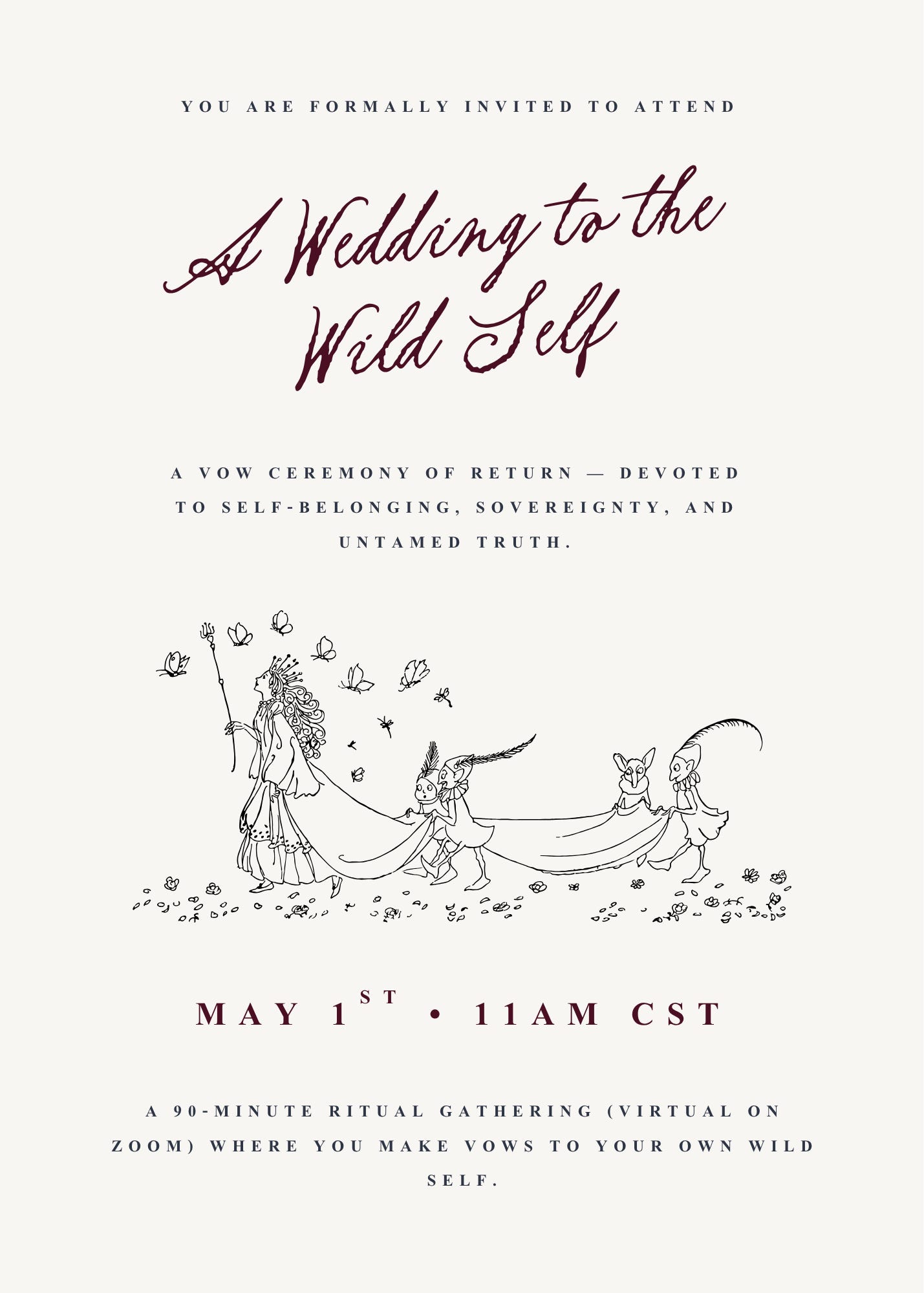
Not between two people. Between each person and their own wild self — the one they’d been keeping in exile behind the wicked voices, the inherited scripts, the geasa they never agreed to carry.
We called it Wedding the Wild Self. And the more I sit with what happened in that room, the more I realize it was the non-fiction version of what Grace does in Ready or Not.
Grace’s costume designer called the wedding dress a “Swiss Army dress.” She ripped it, weaponized it, bled through it, and walked out in it. The symbol of patriarchal submission — the white gown, the institution, the being-given-away — became the tool of liberation. Grace didn’t take the dress off. She repurposed it.
That’s what we did.
First, we named the wicked voices. Not in the abstract. On paper. Every rule, every spell, every inherited prohibition that had been running the show. The ones placed on us by family, by culture, by the men and systems that decided our silence was more comfortable than our truth.
Then we did something the old stories always knew was necessary: we thanked them. We acknowledged what they’d done for us: the safety they’d provided, the invisibility that had once been a survival strategy. We honored the wisdom inside the wickedness.
And then we tore them up. Scribbled them out. Folded them tight and dropped them into bowls and cups. A physical, embodied, irreversible act of casting out.
So it is and so it shall be — these wicked voices are now cast out of me.
Grace tears up the institution of marriage with her bare hands. We tore up the geasa with ours. Grace drops the ring. We dropped the paper in the bowl. Grace walks out covered in blood, smoking a cigarette, sovereign. We walked out holding betrothal tokens to our hearts, sovereign.
Different dress. Same Swiss Army knife.

The Vows Against the Geis
After the casting out, we made vows. Not to another person. To ourselves. Each vow was a line drawn against a specific geis, a new contract to replace the old one. And now, after watching Grace MacCaullay refuse to play by the family’s rules for the second time, I hear these differently. These aren’t just personal affirmations. They’re the Final Girl’s refusal. They’re what Grace would write if she put down the shotgun and picked up a pen.
I vow to protect my Wild Self by refusing what drains me dry. When I feel myself shrinking to be easier to hold, I will stop, breathe, and choose the truer no. — Against the shrinking geis. Grace ripping the dress.
I vow to follow the thread of pleasure like it is sacred evidence. I will give myself one honest delight each day so my life remembers it is allowed to feel good. — Against the denial geis. Grace’s cigarette on the steps.
I vow to speak the truth in real time, not in the post-mortem. When the truth trembles in my throat, I will name it anyway, clean and clear. — Against the silence geis. Grace screaming “In-laws” to the cop who asked.
I vow to take the risk of being seen, messy, growing, unfinished. I will choose the path that costs me my old approval, if it buys me my real life. — Against the invisibility geis. Grace, bloodied and visible and refusing to disappear.
And then the master key — the sovereignty vow, the one that breaks the oldest contract of all:
I vow to belong to myself. I revoke every old contract that made me a guest in my own body, my own desire, my own days. I am not here to be tamed — I am here to be true, and I will choose myself again and again.
Grace at the end… burning it all down from the inside. The old contract says you belong to the family, to the system, to the man who gave you away.
The new contract says: I revoke that. I belong to myself.

The Blessing
After the vows, we held our betrothal tokens to our hearts and spoke the final oath together:
I am not here to be tamed. I am here to be true.
Wild Self, I choose you — again and again.
And something happened in my body that I want to name carefully, because it matters.
For twenty years, my body has been the place where geasa live: where silence lodges, where shame hides, where the wicked voices do their quietest, most effective work.
But the body at that wedding ceremony — holding a ring to her heart in a room full of people who just made vows to their wild selves — is the site where sovereignty lives. Not as a concept. As a sensation. The chest opens. The jaw unclenches. Something that has been gripping since before you had words for it lets go — not because you intellectually decided to release it, but because the nervous system finally believes it’s safe to.
Grace MacCaullay broke it in a blood-soaked wedding dress with a shotgun and her sister’s hand in hers. You can break it in a room full of witnesses with a pen and a bowl and a vow.
The tool doesn’t matter. The breaking does.
May your life recognize you again.
May your no grow teeth.
May your yes grow roots.
May the Wild Self within you always be housed, fed, and honored.
The geis that protected you is the geis that imprisoned you. The sister who witnessed you is the village that freed you. The body that carried the silence is the body that finally spoke.
So witnessed.
Create Your Living Fairy Tales & Myths Map is a self-paced course that walks you through the mythic patterns already operating in your life: your archetypes, your symbols, your recurring narratives, your origin story. The old stories are survival manuals. This course teaches you to read the one you’re already living. More info coming soon.
Such a powerful concept, Jade. Yet another essay that really covers volumes of ideas.
Having a vow to yourself is amazing. Mine was to not abandon myself. It's startling how many decisions both big and small have been informed by that. Do I have a donut or oatmeal for breakfast becomes clearer because my body is harmed by sugar. I wouldn't serve my beloved a donut and I no longer accept it as a choice for me.